Morgan Horse Colors Explained: Bay, Chestnut, Black, Buckskin and More
Walk through a barn of Morgans and most of what you see is bay, chestnut and black. A buckskin Morgan horse or a palomino stands out, and people ask about it first. The range of Morgan horse colors is wider than it looks, though, and it follows a few simple genetic rules that make sense of every coat in the breed.
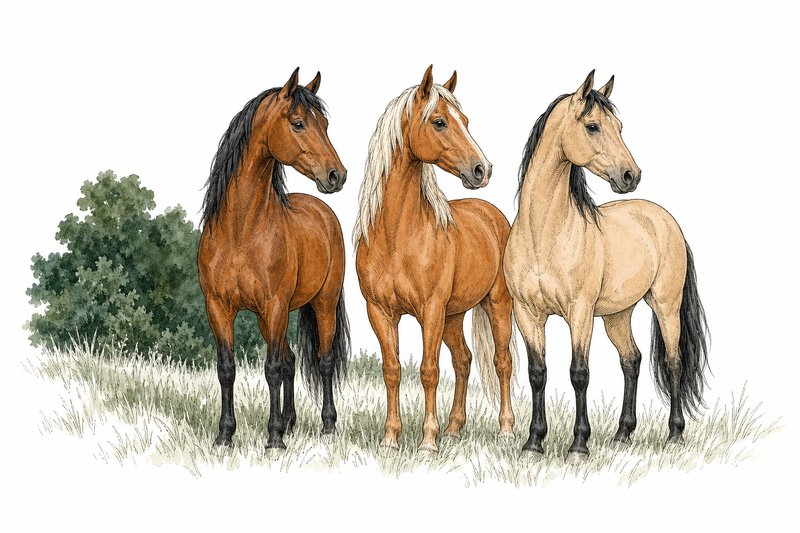
The three base colors behind all Morgan horse colors
Every horse starts from one of two pigments: red or black. One gene, called Extension, decides which one the body can make. A horse with two recessive copies can only make red pigment and is chestnut. A horse with at least one dominant copy can make black pigment, and then a second gene, Agouti, decides where that black goes. With Agouti, black is pushed to the points, the mane, tail and lower legs, and the horse is bay. Without it, black covers the whole body and the horse is black.
Those three base colors, chestnut, bay and black, are the foundation of all Morgan horse colors. Everything else is a modification of one of them: a dilution gene that lightens the coat, a pattern that adds white, or a shade within the base color. Figure himself is usually described as a dark bay, and the breed has stayed mostly in the dark colors he carried.
If you remember one rule, make it this: chestnut is recessive. Two chestnut parents cannot have a bay or black foal, whatever their pedigrees say. A bay or black horse, on the other hand, can hide a chestnut gene and pass it on. That is why a pair of bays can produce a chestnut foal and why breeders who want to avoid chestnut foals test their horses first.
The chestnut Morgan horse
A chestnut Morgan horse has no black hair at all. The body, mane and tail are all shades of red, from a light copper to a dark liver color that can look almost brown. Liver chestnut is common in the breed; in the stallion register it appears on Laughters Uncle Sam, Statesmans Masterpiece and Wintergreen Don Diego. At the other end, a golden chestnut with a light mane is the look of Jubilee King, the great Brunk sire, who was a big golden chestnut with a flaxen mane and tail.
Flaxen, the pale mane and tail on a chestnut body, is a separate trait from the base color and is inherited on its own. It only shows on chestnuts, so a bay or black horse can carry flaxen without anyone knowing. Some chestnut Morgans have a mane and tail with silvery tones rather than true flaxen, which is how several were described in their day, such as Turfwood Royal Flush.
Chestnut is one of the most common Morgan horse colors, and a good chestnut Morgan horse with a deep, even coat is one of the handsomest horses in the breed. It is also the easiest color to predict, because it breeds true.
Bay, brown and black Morgans
Bay is the most common Morgan color. A bay has a red-brown body and black points, with shades from a light blood bay to a mahogany bay so dark it is nearly black. Several of the sport stallions in the register are bay, and dark bay and brown horses, such as Statesmans Silhouette and Oak Knoll Major, sit at the dark end of the range.
A true Morgan horse black is black all over, with no red or brown hairs in the flank, muzzle or around the eyes. Black can fade in strong sun to a brownish tone, so a horse that looks brown in late summer may still be genetically black. Foals are the other trap: many black foals are born a grayish or mousy color and only show their real coat after the first shed. Coal Creek Fly Hawk, GKB Coal Magic and Homeward Mozart are black stallions in the register.
There is a practical reason to test a black horse. A smoky black carries one cream gene but usually looks black or dark brown, and it can pass cream on to its foals. Breeders who are surprised by a buckskin or palomino foal from a black parent are usually looking at a smoky black. A test answers whether a Morgan horse black on the outside is carrying anything else.
Buckskin, palomino and the cream Morgans
The gold colors come from the cream gene. One copy of cream lightens red pigment to gold and leaves black mostly alone. On a bay horse that gives a buckskin: a golden body with black mane, tail and legs. On a chestnut it gives a palomino: a golden body with a white or light mane and tail. On a black horse it gives the smoky black described above. Two copies of cream dilute everything, and the horse becomes cremello, perlino or smoky cream, with a cream coat and often blue eyes.
In Morgan pedigrees the gold has a known source. The buckskin Wheeler Horse 41, a grandson of Justin Morgan, is the main origin of gold color in the breed. His blood came down through horses such as Imperial, whose daughters were crossed with the stallion Glider at the Cross Ranch in Wyoming. Many buckskin and palomino Morgans today trace back to that line.
The buckskin Morgan horse is now popular with riders who want a Morgan that looks different, and the register shows a few: LBF Yukon Gold and Statesmans Sky Hawk are buckskins, while Adiel's Casino Gold, Slate Run RK Ladd and TruWest Sa'Dan Deville are palominos. A buckskin Morgan horse should not be confused with a dun. Dun is a different gene that also lightens the body but adds a dark stripe down the back, and a buckskin has no such stripe.
White markings, patterns and rare colors
Most Morgans have ordinary white markings: a star, a stripe or a blaze on the face and socks or stockings on the legs. Montezsierradon, black with a star and four white socks, is a typical example. For many years the breed's registration rules limited how much white a Morgan could have, but those limits were removed, and horses with more white are now registered.
With that change, white patterns that were always present in the breed became visible. Sabino and splashed white patterns appear in some lines, usually as bold face markings, high white on the legs and sometimes white on the belly. A small number of Morgans also carry the silver gene, which lightens black hair and gives a chocolate body with a pale mane and tail. These colors are still unusual and can be confirmed only by testing.
Colors in the stallion register
The stallion register makes a small but useful sample. Of its 35 sport-bred stallions, nine are chestnut in one shade or another, from flaxen to liver; eight are bay, including two dark bays and a mahogany bay; eight are black; three are brown. The other seven carry cream: five palominos and two buckskins. Bay, chestnut and black together account for 25 of the 35.
The cream horses are worth a second look because of where they come from. Three of the palominos sit in western pedigrees: Triple S Majestic Wind, TruWest Sa'Dan Deville and the cow horse Slate Run RK Ladd. That fits the gold lines coming down from Wheeler Horse 41 through ranch-bred Morgans. The two buckskins, LBF Yukon Gold and Statesmans Sky Hawk, came from eastern breeders, which shows how far the cream gene has travelled since the ranch years.
A color given on old registration papers or in an old sale description is only as good as the person who wrote it down. Horses were described as black chestnut, smoky black or bronze buckskin in their day, and the words do not always match what a test would show. When color matters for a breeding decision, test the horse rather than trusting the description. The test takes a few days and costs far less than a season of guessing.
The same caution applies to foals. A buckskin foal can be born a pale, almost cream color and darken over its first year, and a chestnut foal can shed out redder or lighter than it looked at birth. Registering a foal's color after its first full shed, or after a test, saves correcting the papers later.
Testing and predicting Morgan colors
Color tests are cheap, need only a hair sample and are done by several laboratories, among them the Veterinary Genetics Laboratory at the University of California, Davis. A basic panel covers Extension, Agouti and Cream, which is enough to predict most Morgan foals. Pattern and silver tests can be added when a pedigree suggests them.
For a breeder, the useful questions are simple. Does this horse carry chestnut? Does it carry cream? If both parents carry chestnut, about one foal in four will be chestnut. If one parent carries a single cream gene, about half the foals will be diluted. Knowing that before a breeding saves disappointment and makes it far easier to describe a foal honestly when you sell it.
And for everyone else: color tells you nothing about how a Morgan moves or thinks. The bloodlines page and the stallion register are better guides to that. If you are looking for a horse for sport, start with the Morgan sport horse overview, and let color be the last thing you decide.
Questions and answers
What is the most common Morgan horse color?
Bay, followed by chestnut and black. Brown is also common. Together these account for the great majority of the breed.
Where does the buckskin Morgan horse come from?
From the cream gene acting on a bay horse. In Morgan pedigrees the gold colors trace mainly to the buckskin Wheeler Horse 41, a grandson of Justin Morgan, and came down to modern horses through lines such as Imperial's.
Can two chestnut Morgans have a black foal?
No. Chestnut is recessive, so two chestnut parents can only pass on the red base color. Their foals will be chestnut, or palomino or cremello if a parent carries cream.
Is a Morgan horse black at birth always black as an adult?
Not always. Many black foals are born mousy or grayish and darken with the first shed, and a smoky black carries one cream gene without looking diluted. A color test settles it.
Does coat color affect a Morgan's ability in sport?
No. Color has no bearing on conformation, movement or temperament. It matters for breeding choices and for what buyers ask for, not for performance.